
OncoLattice BioOncology development intelligence

INTELLIGENCE

Connect the evidence. Keep the questions visible.

A site, an investigator, a trial, and a patient pathway tell different parts of the story. Examine how they support—or challenge—the same decision.

Concept illustration: clinical evidence lenses connected around one decision.

Synthetic example

Patient, institution, trial site, and PI in one decision view.

Using site planning as one example, OncoLattice reconciles these evidence objects against one protocol decision—showing where they support each other, where they conflict, and what the sponsor and CRO should validate next instead of exporting separate lists.

SPONSOR DECISIONWhere should this protocol enter targeted feasibility first?
DECISION BOUNDARY
  • Cohort definition
  • Target geography
  • Development stage
EVIDENCE WORKBENCHSelect a lens or evidence row
Supports
Patient opportunity · Patient presence ≠ enrollmentTesting pathway
Evidence classModeled cohort logicConfidenceModerate
Current signal

The synthetic cohort definition connects the required testing step to a plausible care pathway.

Critical conflict
Testing availability does not establish testing completion or protocol eligibility.
Decision implication
Keep the pathway in scope, but do not convert it into an eligible-patient count.
Next validation
Confirm test availability, ordering practice, result timing, and permitted data use.
REVIEWED DECISION OUTPUT
PRIORITYSite 02 / verify firstRATIONALEPatient and site signals partially convergeCONFIDENCEModerate / execution unknowns remainNEXTTargeted CRO feasibility

Fully synthetic illustration. Patient opportunity does not imply access, contactability, consent, or enrollment. A diligence priority is not a final site-selection recommendation.

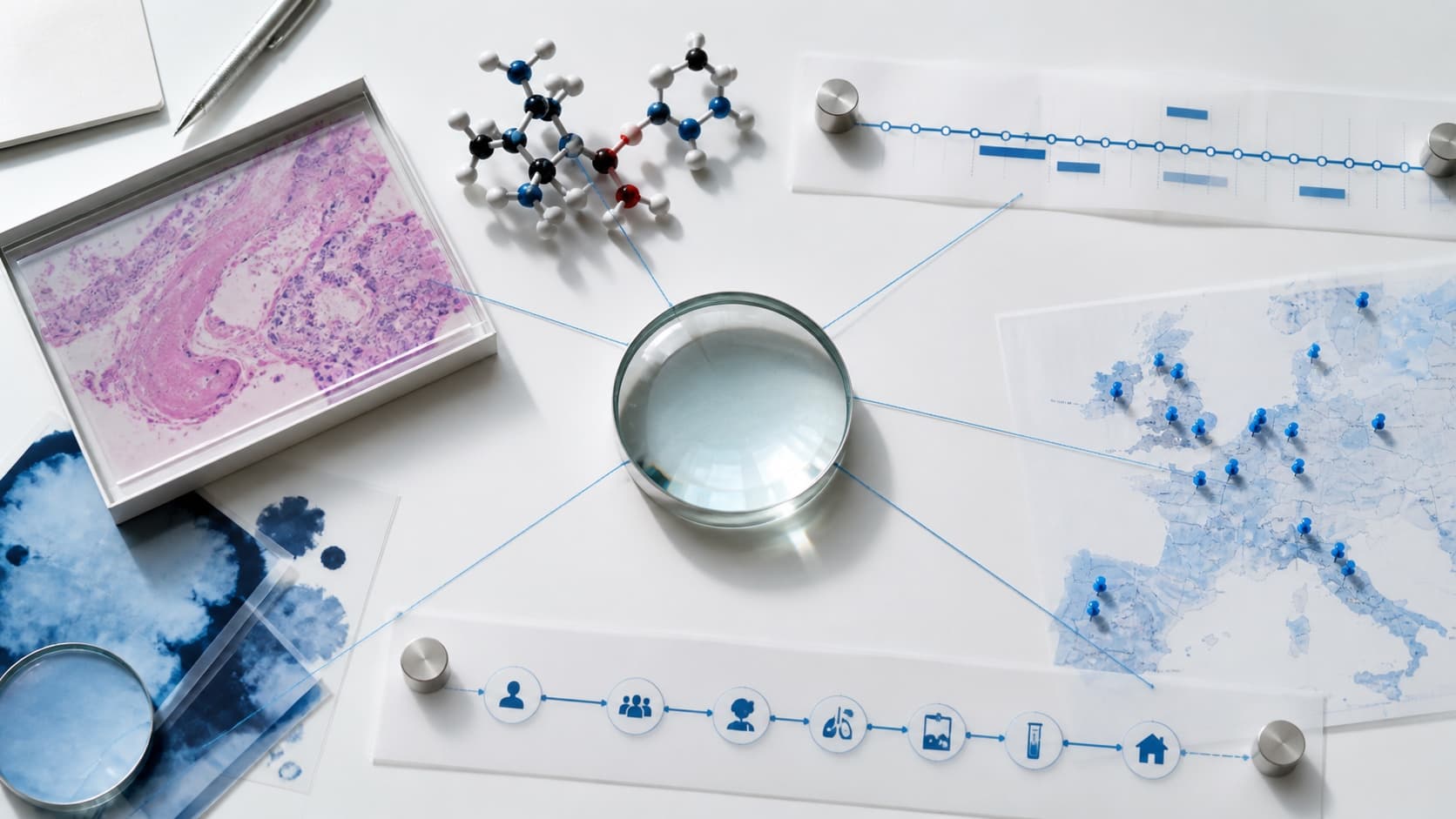
Illustrative evidence desk with pathology imagery, molecular models, a timeline and a map; not patient data.

Seven evidence dimensions. One decision context.

Open a dimension to see what it can tell you—and what it cannot establish on its own.

THE FOUNDATION BEHIND THE MODEL

Structured, selective, time-aware intelligence.

The database is infrastructure beneath the experience. It makes evidence reusable, traceable, and comparable without becoming the product story itself.

01

Connected Entities

Assets and protocols, biomarkers and mechanisms, trials, exact sites, investigators, sponsors, and geographies.

02

Relationship Graph

Sponsor–site history, PI–site affiliations, trial–publication links, collaborator networks, and disease–mechanism relationships.

03

Temporal History

Source snapshots, trial-status changes, site activity, affiliation changes, and recent-versus-prior signals.

04

Derived Intelligence

Protocol-fit features, rankings, execution signals, competitive burden, confidence, supporting evidence, conflicts, and unknowns.

Review status, corrections, unresolved conflicts, and validation history remain linked to the evidence.

The intelligence layer resolves into five things a decision owner can use.

01Rankings02Recommendations03Risks04Confidence05Next actions

START WITH ONE DECISION

A focused pilot begins with a fixed question.

The first engagement is designed to produce an independent signal that can be compared with the sponsor's or CRO's current view.

Discuss a Decision

Outputs are for strategic planning and do not guarantee patient availability, enrollment, site performance, regulatory outcomes, or clinical success.